Newspaper "Svit": "Ukrainian Peace Council-75: Lessons of History and Challenges of Peace in the 21st Century"
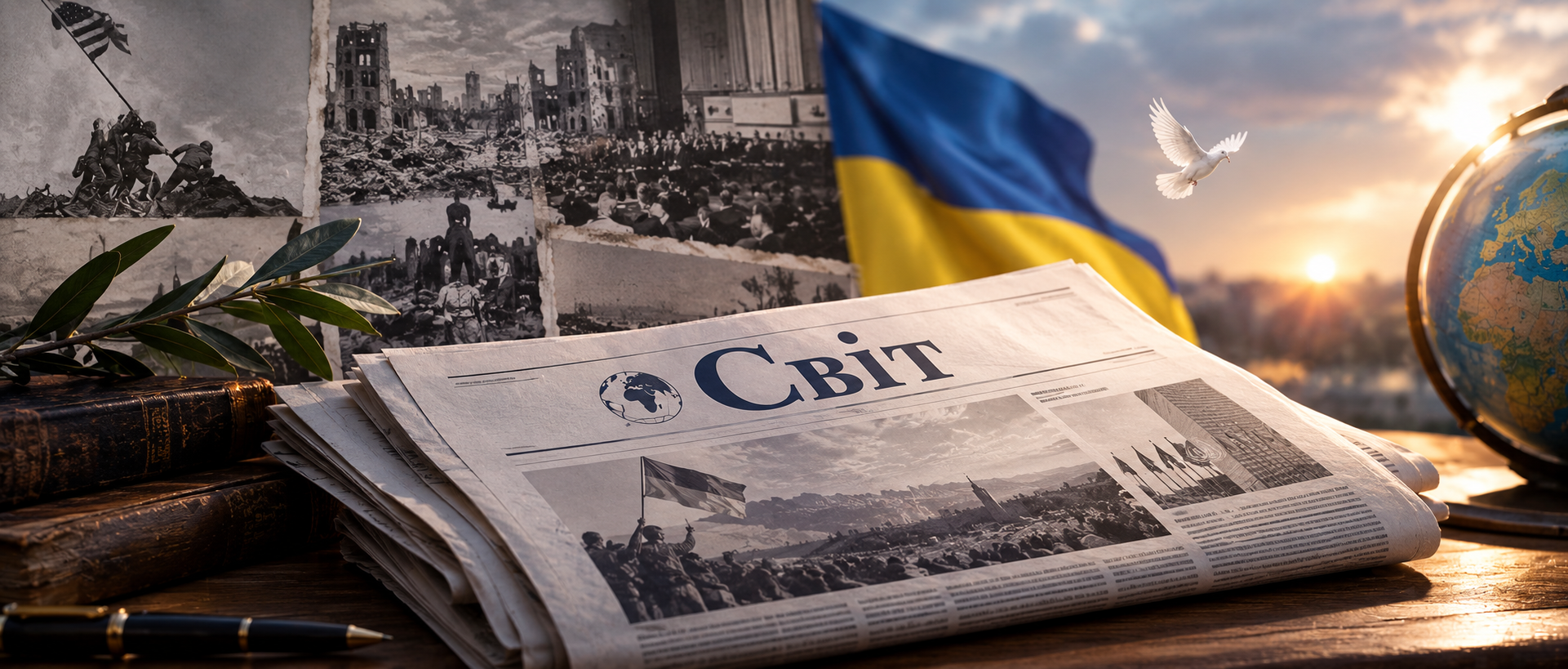
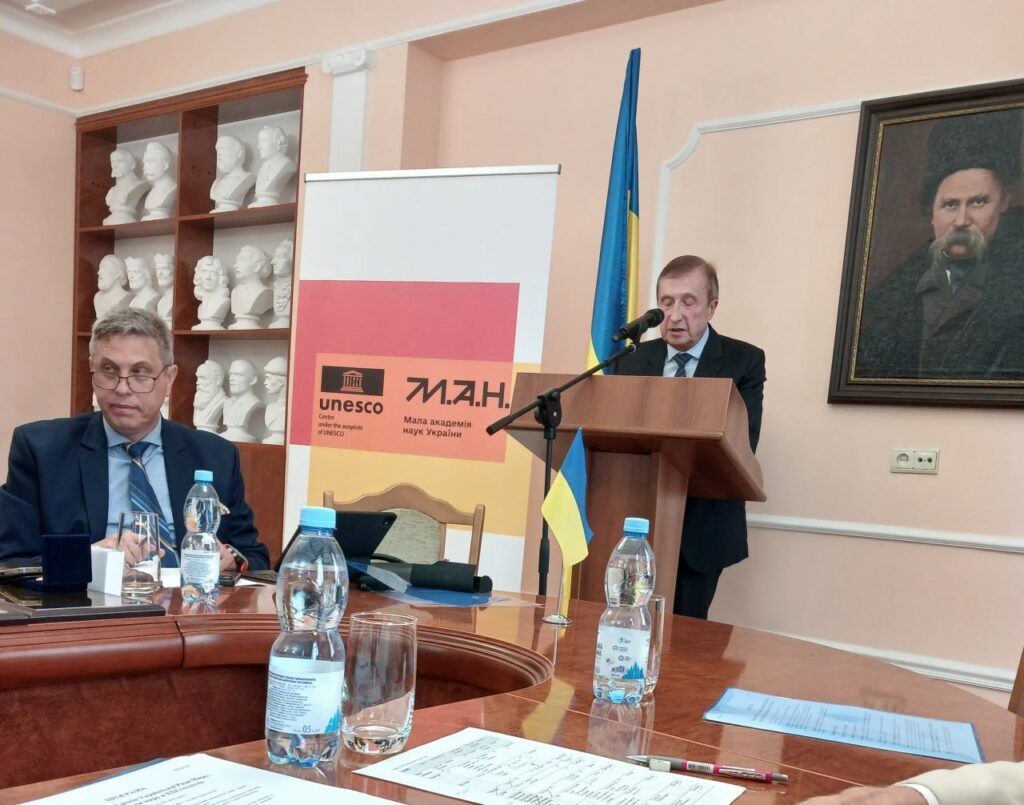
"75 Years of the Ukrainian Peace Council: Lessons of History and Challenges of Peace in the 21st Century" — this was the theme of a roundtable held on the International Day of Peace, September 21. It was on this day in 1951 that the Ukrainian Committee for the Defense of Peace was founded, whose activities in independent Ukraine are continued by the Ukrainian Peace Council. The organizers of the roundtable also included Taras Shevchenko National University of Kyiv and the National Center "Junior Academy of Sciences of Ukraine," on whose premises the event took place. Academic institutions, universities, public organizations, and international partners also joined in organizing it.
On this day, the UPC was congratulated by dozens of scientific and educational organizations, academic institutions and universities, and Ukrainian and international organizations. Greetings from the International President of the World Peace Council, Tageldin Hamad, were conveyed by the head of the Ukrainian representation of the WPC, Mykhailo Ilyin, who highly praised the UPC's activities and the joint partnership work of both organizations. Former WPC International President Dr. Walsh also addressed the roundtable participants online; he has visited Ukraine three times and warmly recalls these trips and meetings with UPC Chairman Leonid Kravchuk. Thomas G. Walsh wished for "the swiftest possible end to this terrible war" and for the further growth of the authority and influence of the Ukrainian Peace Council.
History and the Present
"Peace is not a pause between wars, but a long-term strategy for the development of humanity, based on responsibility, knowledge, and values." This was the main message of the event.
The year 1951, when the Ukrainian Committee for the Defense of Peace was formed, was still not far removed from the bloody Second World War, which spared no Ukrainian family, destroyed cities and villages, and left children orphaned. "Millions of people still lived with the memory of occupation, the front, and the loss of loved ones," said in his speech the Chairman of the Ukrainian Peace Council, Academician of the National Academy of Sciences of Ukraine Mykhailo Zghurovskyi. "And at the same time, the world was already entering a new confrontation, the Cold War was beginning, and 'the emergence of nuclear weapons created a threat of unprecedented scale.'"
The confrontation of ideological adversaries fueled an arms race, and the world more than once found itself on the brink of nuclear catastrophe — until the "evil empire" exhausted its strength and collapsed.
Independent Ukraine embarked on the path of democracy, but peace and good-neighborliness did not prevail in the territory of the former Union. Conflicts on the borders of the former Soviet republics, the longing for the former past and attempts to return the "prison of nations" to the bosom of the "elder brother," provocations and even local wars flared up on the territory of the formerly single state, revealing the desire of neo-imperialists to destroy the will of peoples for freedom and the development of their countries.
In the Ukrainian Committee for the Defense of Peace, and later in the Ukrainian Peace Council, there worked well-known people and true patriots of Ukraine who, in the most difficult periods of our history (and easy ones we have never had), defended Ukraine's interests with honor and dignity. Among them were outstanding scholars — Academicians Mykola Semenenko, Vasyl Komisarenko, Oleksandr Palladin, Borys Paton; writers and artists — Maksym Rylskyi, Pavlo Tychyna, Leonid Pervomaiskyi, Nataliia Uzhvii, and others.
The Ukrainian Peace Council of independent Ukraine was headed by Oles Honchar, followed by Leonid Kravchuk. And in the first year of Russia's full-scale invasion of Ukraine, the UPC was headed by Mykhailo Zghurovskyi.
"Today's date prompts us to reflect on the path traveled and to acknowledge our shared responsibility for a just peace and the future of Ukraine," Mykhailo Zghurovskyi noted in his report. "The goal of our roundtable is to combine historical experience with the search for answers to modern challenges, to develop common approaches to strengthening support for Ukraine, protecting human dignity, and the post-war revival of the state."
Today — for the Sake of Tomorrow
For Ukrainians, peace today has a concrete meaning, emphasized Mykhailo Zghurovskyi. "It is the preservation of life, the return of people home, children's education without the threat of shelling, the return of service members to their families. It is the freedom to live in one's own state, to speak one's own language, to develop culture, and to determine one's future independently." Behind each of these aspirations are human destinies, and this is the main measure of peacemaking activity.
History, responsibility, and civic action are three concepts that are closely interconnected, noted the UPC Chairman. History helps us understand the path traveled. Responsibility defines the moral criteria of our position. Civic action embodies this position in practical work. This was so before, and this is so now.
For the generation that lived through the trials of the Second World War, the preservation of peace was a personal responsibility to the fallen and to their children and grandchildren. For many scholars, writers, and artists, even under the Soviet system, participation in the peace movement was an opportunity to express concern for the future of humanity and to maintain understanding and international human contacts. And knowledge, talent, and public authority imposed additional responsibility on a person.
With the proclamation of independence, Ukrainian society gained the opportunity to speak to the world in its own voice, to independently form international public ties, and to represent its interests and values, emphasized Mykhailo Zghurovskyi.
For the Ukrainian Peace Council, this meant developing citizen diplomacy, promoting social harmony, and strengthening cultural, educational, and humanitarian ties with other countries. The moral authority of Oles Honchar and the statesmanship experience of Leonid Kravchuk contributed to this.
One of the important partnerships of this period was cooperation with the Federation for World Peace. Mykhailo Zghurovskyi recalled the jointly organized international conference "All Humanity — One Family: A New Vision of Peace in the 21st Century." It took place in 2009, and in 2013 UPC representatives took part in the Federation for World Peace summit in Seoul.
Russia's aggression in 2014, the occupation of Crimea, and the war in eastern Ukraine posed fundamental questions for the Ukrainian peace movement: under what conditions does dialogue truly contribute to peace, where is the line between seeking understanding and making concessions to the aggressor, and how can the desire for peace be combined with the protection of sovereignty and people's rights?
Russia's full-scale aggression against Ukraine in 2022 made these questions extremely acute and forced the Ukrainian Peace Council to rethink the philosophy of peacemaking, stated the UPC Chairman. The experience of war has shown that peacemaking cannot be reduced to pacifism or concessions to the aggressor. A just and lasting peace requires a strong and resilient state capable of protecting freedom, sovereignty, and human dignity.
This understanding underlies the updated Program of Action of the Ukrainian Peace Council for the period of achieving peace and the post-war reconstruction of Ukraine. "Peacemaking in the modern sense is systematic work on creating a highly developed, protected state and a democratic society capable of securing such a peace through its own human, technological, and intellectual resources, protecting it, and making it irreversible," explains Mykhailo Zghurovskyi.
The instrument of this policy has become citizen diplomacy. Through international forums, conferences, and expert meetings at the UN, the European Parliament, and Ukrainian and foreign universities, the UPC conveys the truth about the aggression and its consequences, presents the Ukrainian vision of a just peace, and engages international partners in the country's reconstruction.
Today this work is focused around three interconnected directions: environmental and nuclear security; Ukraine's economic revival; and the preservation and development of human capital.
In the "Ecology and Peace" direction, an international forum on the environmental consequences of Russian aggression was held in May 2024 at Igor Sikorsky Kyiv Polytechnic Institute. In November, this issue was presented at UN headquarters in a seminar titled "Environmental Security during War and Armed Conflicts," organized with the participation of the American partner World Information Transfer and the Council for Environmental Security of Ukraine. In 2026, discussion of Ukraine's nuclear security and the lessons of the Chornobyl catastrophe continued at the UN platform. The attention of the international community has been drawn to the destruction of ecosystems, contamination and mining of territories, the destruction of the Kakhovka Hydroelectric Power Plant, and the occupation of the Zaporizhzhia Nuclear Power Plant. The main conclusion: environmental and nuclear risks know no state borders and require shared international responsibility.
The second direction is Ukraine's economic revival. In November 2024, the UPC held an international forum at Vadym Hetman Kyiv National Economic University, which brought together scholars, representatives of the state, business, and international partners around issues of investment, innovation, and structural modernization of Ukraine's economy.
The third direction is human capital. In October 2024, the Ukrainian Peace Council presented its position at the Second Summit "Partnership and Health of Veterans" in the European Parliament, which addressed the rehabilitation of veterans, support for the families of the fallen, and social adaptation of those affected by Russia's war against Ukraine.
In December 2024, the UPC, together with the Federation for World Peace and the Austrian Institute for European and Security Policy, co-organized the international conference "Europe and Ukraine: Common Perspectives and Values," held at the Diplomatic Academy of Vienna.
And in December 2025, an international forum "Education, Science, Innovation: Human Capital in the Post-War Revival of Ukraine" was held at Mykhailo Drahomanov Ukrainian State University. The main idea: the human being is the primary bearer of Ukraine's capacity to defend itself, recover, and develop.
One of the UPC's main tasks within the country is to promote social harmony and the restoration of trust. "We must help society maintain the ability to hear one another, support veterans and the families of the fallen, facilitate the return and reintegration of people, and strengthen ties between generations, regions, and communities. And special responsibility here lies with the scholarly, educational, and cultural communities," notes the UPC Chairman.
The second strategic dimension of the UPC's activity is international. "Ukraine must not only receive solidarity and support from the world, but also take a worthy place in it as a state that has passed through an extraordinarily difficult trial, defended freedom, and is capable of offering its own experience of combining peace, security, democracy, and human dignity," emphasized Mykhailo Zghurovskyi. Therefore, citizen diplomacy must remain one of the main directions of the Ukrainian Peace Council's activity.
At the same time, Ukraine is not only a recipient of international aid but also an active and responsible participant in international cooperation. Our common goal, says the UPC Chairman, is an economically strong, high-tech, and reliably protected state with developed science, modern education, and powerful human capital, in which humanistic values are combined with advanced natural science, technological, and engineering knowledge and competencies.
The role of the Ukrainian Peace Council, he continues, is to be a platform for public dialogue within the country and citizen diplomacy abroad, to unite moral authority, scientific knowledge, and international ties, and to help transform the experience of war into the experience of building a just and lasting peace.
And to fulfill this mission, the Ukrainian Peace Council itself must develop. It must become a powerful intellectual and civic center capable of shaping a strategic vision for Ukraine's future and promoting its realization. To this end, it must engage young people more broadly and develop partnerships with universities, scientific institutions, public organizations, and international institutions. To see perspective, respond to the challenges of the times, and achieve concrete results.

Peace Movements
Over its 75 years, the UPC has made a significant contribution to the development of peace movements, public diplomacy, and the protection of humanistic values. However, the world is changing, and so are the forms of interaction. What will be the transformation of peace movements, and how will ideas about peace, international security, and the role of civil society change in the 21st century? Hero of Ukraine, Academician of the NAS and NAPS, and Ambassador Extraordinary and Plenipotentiary of Ukraine Leonid Huberskyi reflected on this.
Today the international system is experiencing one of its deepest crises since the end of the Second World War, he said. Paradoxically, it is Ukraine — which has lived under armed aggression and Russia's large-scale invasion for 12 years — that speaks most about peace. And this is not something extraordinary, because since the beginning of its independence, Ukraine has consistently demonstrated a constructive position regarding the desire for peace. The clearest proof of this was Ukraine's voluntary renunciation of the world's third-largest nuclear arsenal after the collapse of the Soviet Union. And this is one of the most important contributions to the global nuclear non-proliferation regime.
The speaker also reminded those present of the participation of Ukrainian service members in UN peacekeeping operations in various regions of the world, of the consistent support for the policy of peaceful settlement of conflicts, the strengthening of international law, the protection of civilians, and the development of preventive diplomacy.
Ukraine speaks about peace not only because it has itself become a victim of aggression, continued Leonid Huberskyi. It speaks as a state that for a long time was among the contributors to international peace. And this circumstance, he says, gives the Ukrainian voice particular persuasiveness in the modern discussion about the future of peacemaking policy.
Today humanity faces not only challenges related to military actions. The COVID-19 pandemic demonstrated how interdependent the modern world is. And how important international solidarity is in responding to global crises. Climate change, energy security, and food security are increasingly becoming not only components of international policy but also factors of peace or conflict.
The full-scale invasion of the Russian army became an unprecedented challenge for the entire international security system. At the same time, the international community showed unprecedented solidarity. Ukraine is supported not only by states but also by universities around the world, authoritative scientific institutions, international foundations, public organizations, museums, professional associations, volunteer communities, and millions of citizens around the world.
In effect, a network of solidarity has emerged whose analogue has not existed in modern history. This experience demonstrates the main transformation in 21st-century peacemaking. Its actors are: education and university diplomacy; scientific diplomacy (science, despite everything, is one of the greatest channels of international dialogue); youth as a new subject of peacemaking — they create international cooperation networks, organize volunteer projects, work in international public organizations, and popularize the ideas of peace through modern means of communication; cultural diplomacy, which addresses society directly; and also digital international interaction — digital technologies, which are an instrument of global support for Ukraine.
"And this is a story not only about peacemaking activity but also about a new culture of international solidarity," emphasized Leonid Huberskyi.
Life Has a Chance. But Without Guarantees
Even in conditions of the destruction of the old architecture of international security, peace has a chance, but it is not guaranteed, believes the Honorary President of the National Academy of Educational Sciences of Ukraine, Academician of the NAS of Ukraine and NAPS of Ukraine, and President of the "Znannia" Society Vasyl Kremen.
Globalization has made the world extremely vulnerable to crises: any major conflict almost instantly affects world prices, international logistics, financial markets, and ultimately economic security. "The events of recent years have clearly shown: war is no longer a problem only for two states. Its consequences are felt by countries on different continents," emphasized Vasyl Kremen.
In the conditions of global challenges and hybrid threats, against the backdrop of humanity's rapid technological development, war is no longer limited to open armed confrontation; it is waged in all spaces, including cybernetic and informational, encompassing media and social networks and the digital environment as a whole.
"States have effectively entered into technological rivalry, the results of which will determine not only economic development but also the military-political balance of power in the coming decades," believes Vasyl Kremen. The Russian-Ukrainian war has become one of the first large-scale examples of the use of the latest digital technologies in practically all spheres of combat operations. The use of UAVs and robotic systems, satellite communications, high-precision weapons systems, artificial intelligence for data analysis and combat management, and so on has changed the character of modern war. And at the same time it has demonstrated: despite the rapid development of technologies, human professionalism, patriotism, and moral resilience are of decisive importance, says Vasyl Kremen.
Therefore, an important prerequisite for preventing future conflicts is the formation of a culture of respect for human rights, tolerance, mutual understanding, and a responsible attitude toward social processes. Education acquires special significance in this context, as it shapes worldview, cultivates critical thinking, respect for human dignity, responsibility for one's own decisions, and readiness for dialogue. Technologies are a tool. In whose hands it ends up will determine whether it promotes social development and international cooperation or, on the contrary, becomes a factor in deepening confrontation.
We Will Not Capitulate
Member of the UPC Presidium, writer, Academician of the Ukrainian Academy of Environmental Sciences, Doctor of Medical Sciences, Professor, Ambassador Extraordinary and Plenipotentiary, Shevchenko Prize laureate, and veteran of the peace movement Yurii Shcherbak spoke about the global consequences of nuclear blackmail as a new means of waging war.
"The bloody Russian dictator Putin is intensifying a total genocidal war against Ukraine and threatening European NATO countries with expanded aggression and hybrid attacks. In the Middle East, a conflict is burning that could cause a global energy crisis. In both centers of war, nuclear threats are heard and strikes are carried out on nuclear facilities. The red lines of pre-war time have been crossed. The world is approaching nuclear Armageddon," warns Yurii Shcherbak.
Ukrainians who survived the Chornobyl catastrophe understand this better than others. The world community must unite to avert in time the threat signaled by the Doomsday Clock. This year, on January 27, it was set to the most dangerous mark in its entire history — 85 seconds to nuclear midnight, recalls Yurii Shcherbak. Humanity has very little time left to avert the worst scenario and move away from the path of self-destruction. This prompts not only reflection on the lessons of the past but also decisive action.
"I had the high honor of working in the Ukrainian Committee for the Defense of Peace, headed by Oles Honchar since 1985. Despite the fact that the Soviet peace movement worked under the control of the Communist Party and the KGB in the interests of the USSR's foreign policy, it corresponded to the deep interests of society in living in conditions of peace and nuclear security," says Yurii Shcherbak. "The global nuclear catastrophe at the Chornobyl Nuclear Power Plant in 1986 put Ukraine at the epicenter of world attention, showed the danger of destroying nuclear facilities, gave rise to a powerful environmental resistance movement, and became one of the factors in Ukraine's achievement of state independence."
Today, when Russian occupiers shell the Chornobyl NPP and place weapons on the territory of the Zaporizhzhia Nuclear Power Plant they have seized, Ukraine has many questions for the IAEA. As in 1986, when representatives of the Ukrainian Committee for the Defense of Peace met with IAEA leadership and expressed protest against the organization's policy of double standards.
"Meanwhile, nuclear weapons have become for Russian chauvinists an integral part of their 'victory fervor,' their arrogant conviction of the right of Russians to dictate their conditions to other peoples and impose the matrix of the 'Russian world,'" emphasizes Yurii Shcherbak. Putin and his accomplices constantly threaten Ukraine with the use of nuclear weapons, which, according to international law, is an act of international nuclear terrorism. He proposed appealing to the International Criminal Court in The Hague with a demand to condemn the nuclear terrorists of the Russian Federation led by the Kremlin elite. He considers it appropriate to send another appeal to the authoritative international organization "International Physicians for the Prevention of Nuclear War" (IPPNW), headquartered in a suburb of Boston (USA) with a representative office in Geneva (Switzerland).
After the invasion of non-nuclear Ukraine by a nuclear state, the very vision of peace changed, added Yurii Shcherbak in conclusion: "We will not capitulate for the sake of a phantom peace. For us, peace is guaranteed security… Our peace is the punishment of Russian war criminals."
Humanitarian Militancy
Peace as a model for organizing life and the peacemaking role of education were discussed in the speech of the Rector of Mykhailo Drahomanov Ukrainian State University, Academician of NAPS of Ukraine and Corresponding Member of the NAS of Ukraine, Viktor Andrushchenko.
"To the question of what the world and education should be like during war and in the post-war period of society's development, there can be only one answer: people-centered, intelligent, orderly, and therefore life-affirming and peacemaking," believes Viktor Andrushchenko.
In times when the fate of civilization is being decided, the idea of peace is the unifying factor that will promote the solidarity of peoples in the face of common threats and bring closer the prospect of building a more just world. We must understand that peace is not only the absence of war but also a model for organizing life without violence and cruelty, life in dialogue among world cultures, each of which is unique and valuable. It is precisely such basic convictions, in his opinion, that peacemaking education should form. And it is also important to understand that peace is creative work that ensures the well-being and comfortable existence of humanity, but above all it is a people's capacity to protect their land and culture from any hostile encroachments.
"Peacemaking education must unfold in the paradigm of humanitarian militancy, the cultivation of convictions regarding the necessity of producing defensive weapons, and at the same time, the establishment of barriers to counter hostile ideological influences," emphasizes Viktor Andrushchenko.
Peace for Kravchuk Was a Value Category
Leonid Novokhatskyi, Deputy Chairman and Director of the Ukrainian Peace Council, Candidate of Political Sciences, Ambassador of Peace, and veteran of the peace movement, used his participation in the discussion as an opportunity to reflect on the path traveled by the Ukrainian Peace Council over 75 years and to honor the people who, through their authority and work, determined the mission and shaped the history of this public institution.
"Today we perceive the history of the Ukrainian Peace Council as a single continuous tradition. Each of its stages had its own characteristics and corresponded to the challenges of the time," he noted.
The restoration of Ukraine's Independence in 1991 became a new historical stage for the organization. The UPC faced the task of preserving the best achievements of the past and at the same time establishing itself as a modern independent institution of civil society.
"In this turning point, a leader was needed who could combine statesmanship thinking, international authority, political wisdom, deep humanism, and indisputable moral authority. That is why in 1997 the Ukrainian Peace Council turned to the first President of independent Ukraine, Leonid Makarovych Kravchuk," recalls Leonid Novokhatskyi. This strategic choice determined the development of the UPC for a quarter of a century, until 2022.
The first president of independent Ukraine brought to the Peace Council a special culture of dialogue, respect for the individual, the responsibility of a statesman, and a deep conviction that peace is, above all, a value category, says Leonid Novokhatskyi. "For him, peace never meant merely the absence of war. It was based on truth, justice, freedom, mutual trust, responsibility before society, and respect for human dignity," noted the speaker.
During Kravchuk's chairmanship, the UPC became an important participant in international dialogue and public diplomacy, established itself as an influential independent institution, and finally transformed from a post-Soviet legacy into a center that consistently defends Ukraine's national interests. "Under his chairmanship, the organization significantly intensified its international activity, expanded cooperation with authoritative international public organizations of the world, and consistently represented Ukraine at international forums, conferences, and humanitarian projects. Its voice sounded increasingly confident in the international peace movement, and the organization itself established itself as one of the most authoritative subjects of public diplomacy in Ukraine," emphasized Leonid Novokhatskyi.
***
The roundtable participants discussed the speeches and adopted the Declaration of the Roundtable Participants "75 Years of the Ukrainian Peace Council: Lessons of History and Challenges of Peace in the 21st Century" and Recommendations on strengthening a just peace, international solidarity, and promoting Ukraine's revival. They addressed their proposals to state authorities, local self-government bodies, UPC structures, public organizations and international partners, universities, scientific and cultural institutions, and youth organizations.
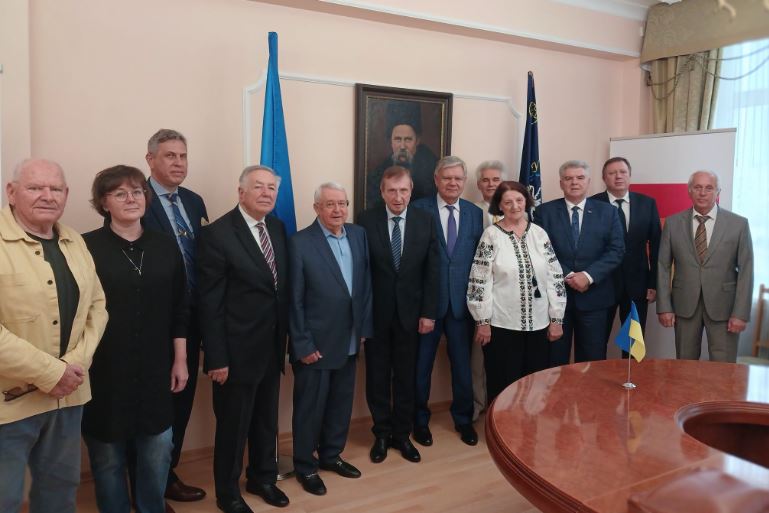
The roundtable documents called on Ukrainian and international institutions, communities, academic and educational communities, business, and citizens to work together for a just peace and the revival of Ukraine.
As UPC Chairman Mykhailo Zghurovskyi summarized: "Our task is to help Ukraine endure today, revive tomorrow, and become a free, strong, and peaceful state capable of achieving a just peace, protecting it, and passing it on to future generations."
Newspaper "Svit"
Peace as a long-term strategy for the development of humanity – Newspaper "Svit"