Round table discussion: “The Chernobyl Disaster: Lessons from the Past and the Challenges of Nuclear Safety Today”

Under the title “40th Anniversary of the Chornobyl Disaster: Lessons from the Past and the Challenges of Nuclear Safety Today”, a round table was held in Kyiv at JSC “NNEGC “Energoatom”, bringing together representatives of civil society (including Chornobyl cleanup workers and their descendants), modern energy professionals who are confronting Russia’s nuclear terrorism in the 21st century, scientists, educators, both national and international experts, as well as high-ranking officials.
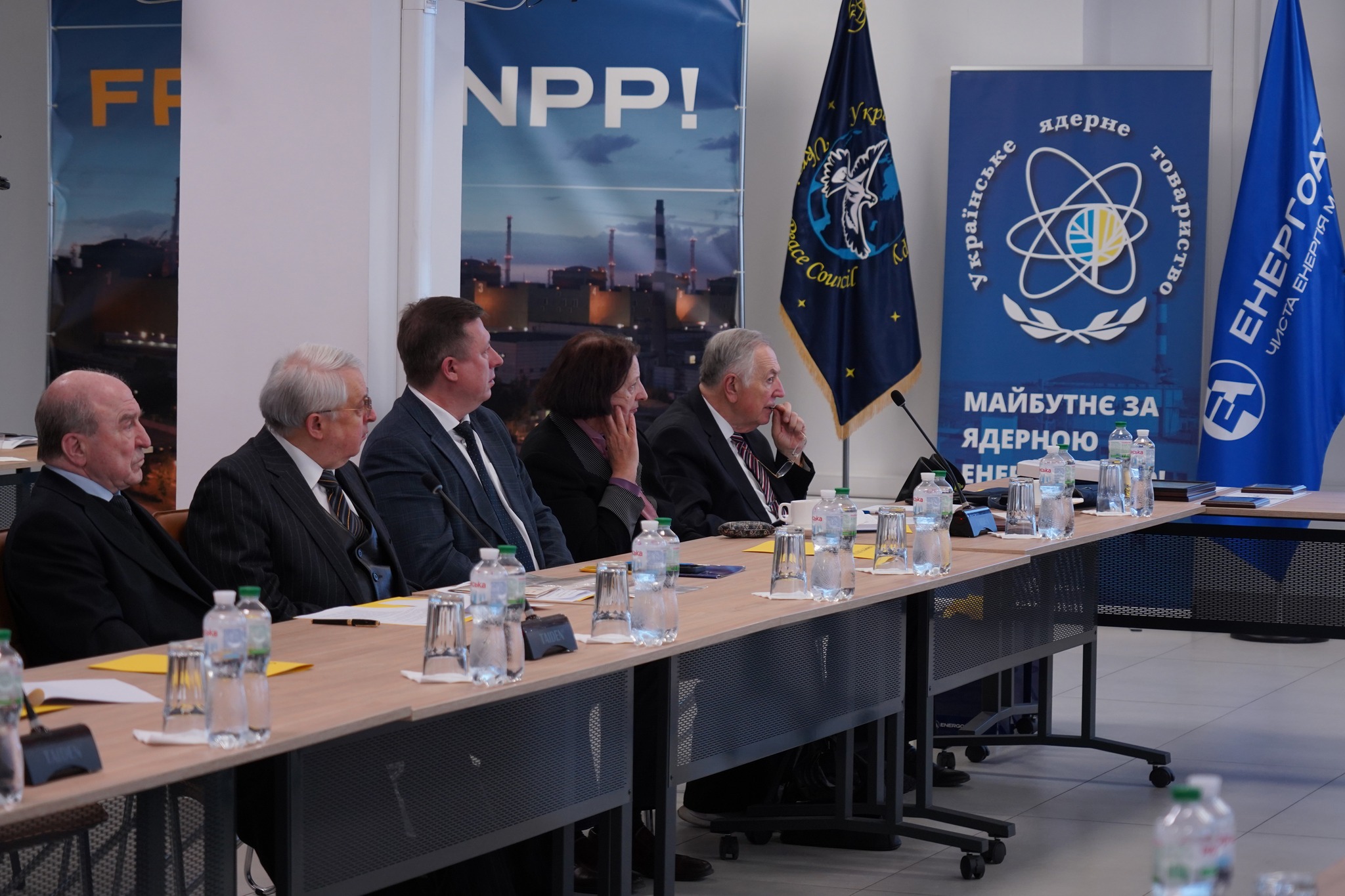
The event was organized by JSC “NNEGC Energoatom”, the Ukrainian Peace Council, the National Academy of Sciences of Ukraine, and the public organization “Ukrainian Nuclear Society”.
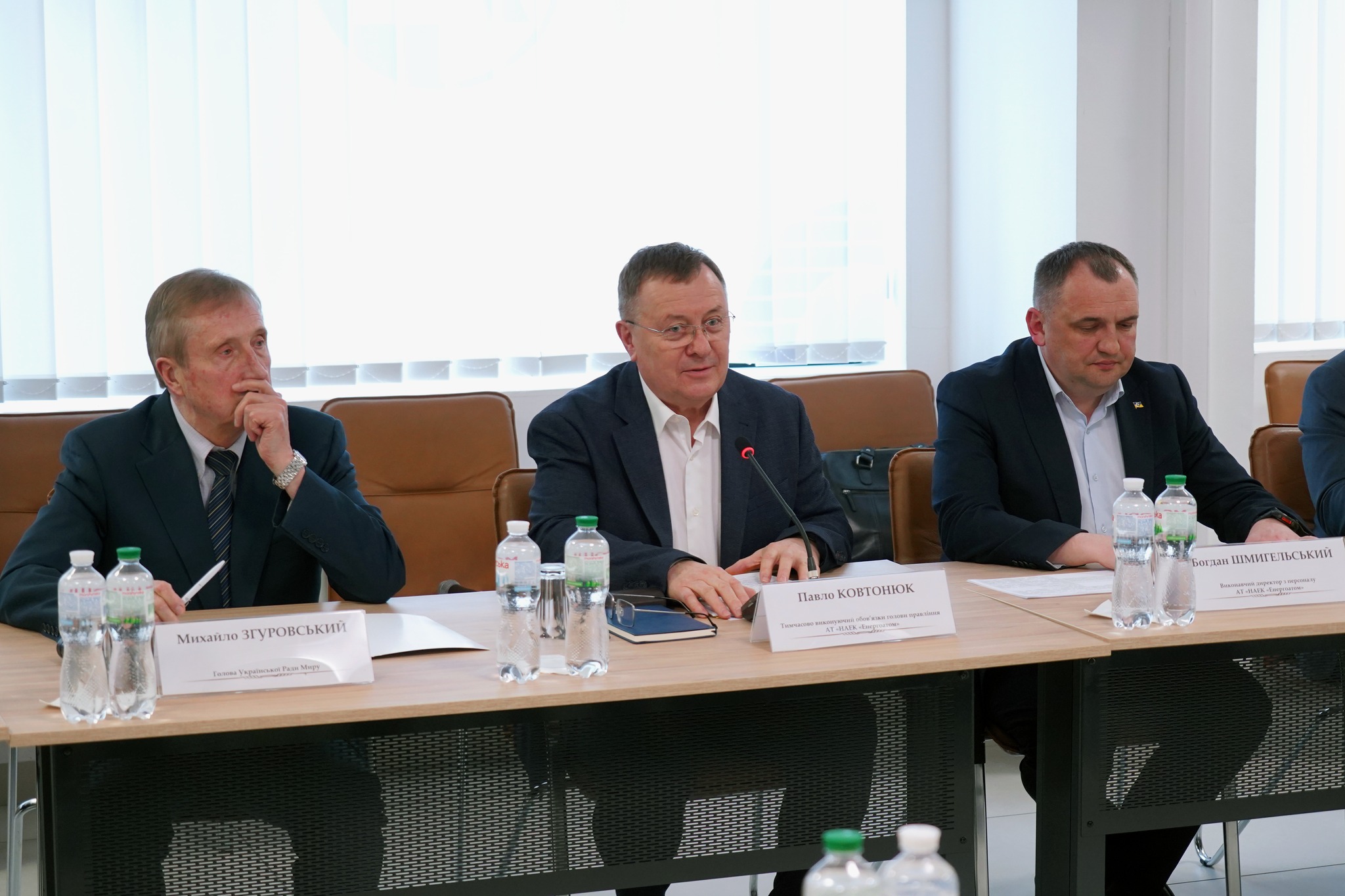
Opening the meeting, Acting Head of JSC “NNEGC “Energoatom”, Chornobyl clean-up worker Pavlo Kovtoniuk emphasized that April 1986 forever changed not only millions of human lives, but also the consciousness of humanity as a whole, which realized that nuclear safety must be an unconditional and absolute priority. “Responsibility for peaceful nuclear energy lies with each of us,” he noted. “Ukraine, more than any other country, has deeply learned these lessons.” Pavlo Kovtoniuk also called on those present to honor the memory of the Chornobyl clean-up workers and the defenders of Ukraine who gave their lives for the freedom and sovereignty of the state.
In the greeting of the President of the National Academy of Sciences of Ukraine, Academician Anatolii Zahorodnii, read by Vice President of the NAS of Ukraine, Academician Oleksii Rafalskyi, it was noted that more than two thousand employees from 42 scientific institutions of the Academy participated in the liquidation of the consequences of the disaster. It was emphasized that today, in the conditions of Russia’s armed aggression against Ukraine, which is accompanied by unprecedented manifestations of nuclear terrorism and creates constant threats to nuclear and regional security not only of Ukraine but of the entire world, the Ukrainian scientific community remains ready to continue playing a leading role in the scientific support of state policy in the field of nuclear safety, the development of advanced technologies, and the formulation of effective solutions to counter modern threats.
The Chairman of the Ukrainian Peace Council, Academician of the National Academy of Sciences of Ukraine Mykhailo Zgurovskyi, also addressed the participants. “Today we are gathered not only to commemorate this tragic date, but also to deeply reflect on the transformation of the global nuclear safety system,” he stressed. The Fukushima Daiichi nuclear accident in Japan in 2011 demonstrated that even highly developed technological countries are not immune to nuclear risks. The war in Ukraine has revealed a fundamentally new reality in which nuclear infrastructure becomes an object of military operations. The world has witnessed unprecedented challenges: the military occupation of the Zaporizhzhia Nuclear Power Plant, the strike by an unmanned aerial vehicle on the protective shelter of the fourth reactor unit of the Chornobyl Nuclear Power Plant, as well as the constant threat of missile and drone attacks in the areas where Ukraine’s nuclear power plants operate, which provide a significant share of the country’s energy balance. This is a new reality where military risks and nuclear threats are intertwined, carrying potentially global consequences.
Today, nine states possess or de facto possess nuclear weapons, Academician Zgurovskyi noted. At the same time, interest in acquiring nuclear status is growing in other countries and regions of the world. In this context, a key question arises: what comes next, and how can catastrophic global scenarios be prevented? The round table is intended to serve as a clear signal to the international community that nuclear safety is inseparable from issues of war and peace, and that responsibility for maintaining global security is shared by all states and peoples.
A representative of the Embassy of Japan in Ukraine, Tadayoshi Hiraki, also addressed the participants of the round table. He noted that Japan provides comprehensive assistance to Ukraine in the fields of energy, demining, education, healthcare, and financial support.

Mr. Hiraki noted that he was personally present at the Fukushima Daiichi Nuclear Power Plant site in the days of the accident, and therefore fully understands the complexity of the situation and the challenges Ukraine is facing today. He emphasized the importance of a consolidated position of the international community in condemning Russia’s actions and supporting Ukraine. Since the beginning of the full-scale invasion, Japan, through the IAEA, has provided €27 million to ensure the safety of Ukraine’s nuclear facilities and will continue to work in coordination with international partners to promote initiatives in the field of nuclear safety.
What is it — a cornerstone of stability for the energy system?
“The transformation of nuclear power plants from 1986 to the present day” was the topic of the presentation by the Head of JSC “NNEGC “Energoatom”, Pavlo Kovtoniuk, which opened the main expert part of the round table.
“Today I want to speak not only about the lessons of the past, but also about the tremendous path Ukrainian nuclear energy has taken over these years,” Pavlo Kovtoniuk noted. It is a story of how safety became an absolute priority for energy professionals, how the highest global standards were achieved, and what unprecedented challenges the industry has faced when its infrastructure found itself at the center of a full-scale war.
“Energoatom today is 25,000 highly qualified employees, including 359 unique specialists — licensed operational personnel,” Kovtoniuk emphasized. “After gaining independence, Ukraine chose the path of maximum transparency: we joined international agreements and voluntarily opened our nuclear power plants to the most stringent international oversight. Our nuclear facilities are always ready for inspections, and international supervision for us is a tool of continuous self-improvement.”
“We implemented a comprehensive nuclear safety enhancement program financed through Energoatom’s own funds and loans from European banks, with a total value of UAH 39.5 billion and €600 million in credit resources,” he explained. “So far, 1,116 out of 1,295 planned measures have already been implemented. Compliance with these strict requirements is a mandatory condition for extending the operational lifetime of power units.”
“Ukrainian nuclear energy has become a cornerstone of stability for the energy system in the most difficult period of the war,” he emphasized. Today, nine nuclear power units in Ukraine generate more than half of the country’s total electricity, and during the autumn-winter periods this share reached up to 70%. This is a powerful resource that allows the state to function and resist aggression.
Even in wartime conditions, energy professionals are working for the future. Projects for the completion of Units 3 and 4 of the Khmelnytskyi Nuclear Power Plant are underway. While previously VVER-1000 reactors from Bulgaria were considered, other realistic options are now being evaluated. Preparations have begun for the construction of Units 5 and 6 using the American AP1000 technology developed by Westinghouse.
Together with Westinghouse, Ukraine plans to build nine such reactors — not only at Khmelnytskyi but also at the South Ukraine and Rivne NPPs, as well as at a new site near Chyhyryn.
The response to the challenges of decentralization is the development of small modular reactors alongside large ones. These projects are currently moving from strategic planning to the preparation of an industrial base. The construction of up to 20 such power units is planned, which will increase the resilience of Ukraine’s energy system to external shocks and contribute to its decentralization. At the same time, Europe’s energy security is impossible without the full de-occupation of Ukraine’s nuclear power plants and their return under Ukrainian control.
Lessons of Chernobyl and Fukushima
The President of the Ukrainian Nuclear Society, former Minister for Emergency Situations, and Chornobyl clean-up participant Volodymyr Kholosha dedicated his speech to the topic: “Lessons of Chernobyl and Fukushima: From National Tragedies to Global Responsibility.”
Both accidents are the most severe in the history of civil nuclear energy, he noted. According to the International Nuclear Event Scale, both are rated at the highest — Level 7. The Fukushima accident, like the Chornobyl disaster, involved significant releases of radioactive substances, although their scale was dozens of times smaller. The Chornobyl catastrophe exceeded Fukushima in terms of duration and overall consequences: radioactive contamination affected vast territories, impacted the health of millions of people, led to the evacuation of dozens of settlements, and caused enormous economic losses — about $300 billion over 30 years.
Today, the Chornobyl Nuclear Power Plant, like other stations, cooperates with the international community to strengthen nuclear safety standards. In June 2012, Ukraine and Japan signed an agreement on cooperation in overcoming the consequences of the Fukushima accident, which provides for the exchange of experience.
Both tragedies demonstrated important lessons for the world. In particular, they showed how a prolonged loss of power supply can lead to the failure of reactor cooling systems (a concern also relevant to the situation at the Zaporizhzhia Nuclear Power Plant). After the Fukushima accident, international organizations revised nuclear safety standards, significantly expanding the list of risk factors taken into account in assessment and response procedures.
The Chornobyl Disaster: The Human Dimension
Yurii Shcherbak — a renowned writer, this year’s Shevchenko Prize laureate, diplomat, and statesman, and the first Minister of Environmental Protection of independent Ukraine. He authored one of the first documentary books about the disaster, “Chornobyl.”
“Forty years ago, black radioactive swans rose over Ukraine, heralding the beginning of a new era of anxiety, change, and global instability,” he noted. “A new surreal territory — the Zone — appeared forever on the world map.”
The explosion of the RBMK reactor, which he described as a gigantic radioisotope bomb, occurred not as a result of war or terrorism, but due to a fatal flaw in the technological system and gross errors in its operation.
Over the 40 years since the Chornobyl disaster, the world has undergone unprecedented geopolitical changes: the Soviet Union collapsed, independent Ukraine became a central actor in global affairs, and Russia turned into an aggressive state waging war against Ukraine and threatening the world with nuclear weapons. At the same time, generations are growing up who know little or nothing about the Chornobyl tragedy.
However, Chornobyl must not be forgotten, Yurii Shcherbak emphasized. It remains a symbol of global danger, a scientific and psychological challenge for all humanity.
According to the IAEA, as of 2025, there are 416 nuclear reactors operating in 32 countries, 23 reactors have been permanently shut down, and 66 new reactors are under construction in 17 countries, mainly in China and India. Nuclear energy continues to carry the potential risk of catastrophes similar to Chornobyl, but in new historical and technological conditions.
Yurii Shcherbak called on participants to support the documents of the Ukrainian Peace Council — the declaration and recommendations on international and nuclear security. Today is a time of remembrance and reflection, a time of sorrow and pride, and also a time for action.

The Occupation of Zaporizhzhia NPP as a Global Nuclear Threat
Dmytro Verbytskyi, Acting Director General of the Zaporizhzhia NPP branch, informed participants of the round table about the circumstances of the plant’s occupation, the actions of Russian forces, and their impact on nuclear and radiation safety not only in the Zaporizhzhia region but globally.
“I am a direct witness of the events of early March 2022,” he noted. “I could not believe it could happen — neither on the first, nor on the second, nor even by the evening of the third day. But it did happen. On the night of March 3 to 4, Russian forces seized the Zaporizhzhia Nuclear Power Plant. For the first time in history, a strategic nuclear facility came under occupation, creating unprecedented risks for the global nuclear safety system.”
The plant was subjected to shelling with heavy weapons, including tanks. Despite the mortal danger, operational personnel continued to perform their duties, ensuring the nuclear and radiation safety of the facility.
Russian military forces turned the NPP site into a military base: industrial facilities were used to store weapons, explosives, and heavy equipment, to establish firing positions, and to accommodate personnel, including within the crisis center.
Training areas for drone operators were also set up on the plant’s territory, used for strikes against civilian infrastructure and populations in Nikopol and surrounding areas.
Since September 2022, the Zaporizhzhia NPP has not been generating electricity, and its territory has been mined. At the same time, a nuclear power plant cannot operate without external power supply. Since the beginning of the occupation, the plant has experienced 14 complete blackouts, the most recent occurring on April 16. Last autumn, one such blackout lasted 30 days, during which the plant operated solely on diesel generators that had not undergone proper maintenance for an extended period.
The situation was further aggravated by the destruction of the Kakhovka Hydroelectric Power Plant, which led to the depletion of the water source used for cooling systems at Zaporizhzhia NPP.
“This story of Russian crime has been ongoing for five years already. The Zaporizhzhia NPP must be urgently de-occupied and returned under the control of its sole legitimate operator. Only in this way can global nuclear safety be guaranteed,” Dmytro Verbytskyi emphasized.
The Consequences of the “Chornobyl Syndrome”
Chornobyl caused not only radiological consequences but also large-scale social and governance problems — the spread of fear and myths, the formation of inefficient compensation systems, and overly strict regulatory standards. This was emphasized by Anatolii Nosovskyi, Director of the Institute for Nuclear Power Plant Safety Problems of the National Academy of Sciences of Ukraine, Chornobyl clean-up participant, and academician.
According to him, the total number of clean-up workers exceeded 600,000 people, although the level of actual participation varied significantly. He paid special attention to the construction of the “Shelter” object, where 21,545 people worked, with an average radiation dose of 8.7 rem. In comparison, ChNPP personnel in 1986 received an average of 31 rem, while decontamination workers received 17 rem.
These data, the scientist noted, reveal a paradox: although work at the “Shelter” was considered the most dangerous, some other participants in the liquidation received significantly higher doses. He attributed this to insufficient competence in planning hazardous work and neglect of safety requirements.
Anatolii Nosovskyi also critically assessed the state policy of social protection for affected individuals. He pointed to a sharp increase in disability rates among clean-up workers after 1991, which, in his view, was not accompanied by a corresponding increase in mortality. This may indicate deficiencies in establishing cause-and-effect relationships between illnesses and the consequences of the accident, as well as the formation of distorted socio-economic incentives.
He also addressed the issue of population resettlement from contaminated areas. According to his assessment, this process caused significant losses both for the state and for individuals, partly due to excessively strict radiation safety standards that were lower than natural background levels in many regions of the world.
Regarding the future of the Chornobyl Exclusion Zone, the academician noted that it will continue to be used for the needs of Ukraine’s nuclear industry. Facilities for handling radioactive materials have already been established there, and the accumulated experience in dismantling and waste management has significant international potential.
In his view, the exclusion zone can become a scientific and technological testing ground for developing advanced solutions in decommissioning, training specialists, and even hosting new nuclear facilities. At the same time, he criticized the idea of turning the zone into a tourist site, stressing that its primary function is containment of radionuclide spread, and therefore only limited, science-oriented tourism could be acceptable.
The President of the international organization World Information Transfer, Dr. Khrystyna Durbak, in her speech emphasized the organization’s long-standing work in environmental safety and international information exchange. She recalled that after the 1986 Chornobyl disaster, the organization actively assisted Ukraine, and since 2014 has supported it under conditions of Russian aggression.
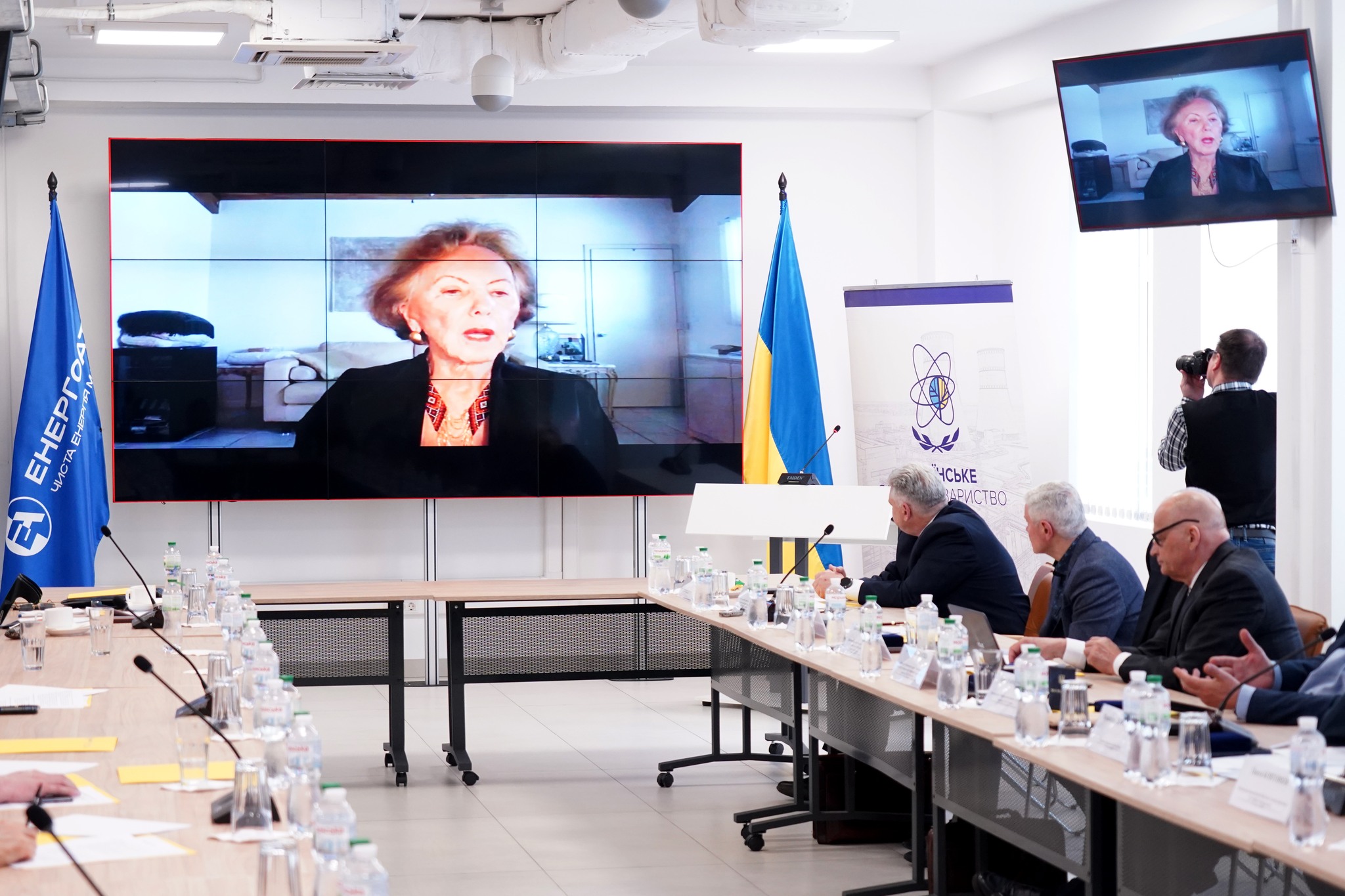
Ms. Durbak called on democratic countries to strengthen unity and increase pressure on the aggressor through diplomatic instruments and international organizations. She emphasized that Ukraine’s struggle is important not only for the state itself, but also for global stability and the security of future generations.
A New Nuclear Doctrine Is Needed
The experience of Chornobyl significantly influenced the political decisions of the early 1990s, which later had dramatic consequences for Ukraine, said statesman and former Minister of Ecology and Nuclear Safety of Ukraine Yurii Kostenko.
“The Chornobyl syndrome influenced the decisions of the Verkhovna Rada of Ukraine and became one of the factors shaping the initial course toward nuclear disarmament,” he noted.
At the same time, according to Yurii Kostenko, after independence was declared, parliament realized that a non-nuclear status was possible only with clear security guarantees. The Ukrainian plan envisaged the elimination of nuclear weapons (rather than their transfer), implementation of this process with international financial and technological support, and legally binding guarantees of national security.
However, in his view, a strategic mistake occurred: nuclear disarmament followed a different scenario. Ukraine effectively transferred not only nuclear warheads to Russia free of charge, but also delivery systems — strategic aviation and missiles. At the same time, the country lost the opportunity to use highly enriched uranium for its own energy needs.
Yurii Kostenko also recalled the position of the United States in 1992–1993. According to him, the U.S. considered guaranteeing Ukraine’s security through NATO membership and also proposed the creation of an international fund to finance nuclear disarmament, modeled on EBRD Chernobyl programs.
In addition, a technological solution was proposed to convert highly enriched uranium into fuel for Ukrainian nuclear power plants with the participation of General Atomics. However, these initiatives were not implemented due to the political approaches of that time.
Assessing the current situation, Yurii Kostenko criticized the role of the IAEA, which, in his opinion, has failed to respond adequately to the challenges of war, particularly by not properly recognizing Russia’s actions as acts of nuclear terrorism.
He also pointed to a dangerous global trend of renewed nuclear arms racing: while in the early 1990s about 20 countries potentially had military nuclear programs, today the number is around 40.
In these conditions, Kostenko stressed, the world needs a new nuclear doctrine, and Ukraine should take the initiative.
The Director of the Institute for Nuclear Research of the National Academy of Sciences of Ukraine, Academician Vasyl Slisenko, focused on nuclear safety issues. He emphasized that the operation of nuclear power plants requires constant technical monitoring, equipment modernization, and strict compliance with regulations.
He distinguished between technical and physical safety: the first aims to prevent accidents and minimize their consequences, while the second focuses on protecting nuclear materials from sabotage, theft, and unauthorized access.
In conditions of political instability and growing terrorist threats, he said, the risk of radioactive materials being used by criminal groups increases. A particular danger is the situation at the Zaporizhzhia NPP, where military presence, shelling, and power supply disruptions create direct threats to nuclear safety.
Is the World Ready for Peace?
Former Minister of Environmental Protection and Natural Resources of Ukraine and Head of the Ukrainian Society for Nature Protection Vasyl Shevchuk stated that global security mechanisms have in fact been destroyed.
He emphasized the collapse of the international deterrence system that was supposed to ensure nuclear non-proliferation and collective security. According to him, the modern world stands before a choice between chaos and the preservation of a harmonious world order, with the first scenario, unfortunately, appearing more likely.
Among possible responses, he named:
• restoring the role of international institutions, primarily the UN;
• initiating an international convention on the prohibition and elimination of nuclear weapons by Ukraine and Japan;
• using the potential of new technologies, including artificial intelligence, to neutralize nuclear threats.
He also drew attention to the environmental aspect of the war: according to him, thousands of missiles have been launched during Russia’s full-scale aggression, negatively affecting the ozone layer and the atmosphere due to harmful emissions.
Intellectual Contribution
Summarizing the discussion, the moderator of the round table, Chairman of the Ukrainian Peace Council Mykhailo Zgurovskyi, noted that participants made a significant intellectual contribution to the study of the consequences of the Chornobyl disaster and the understanding of modern nuclear threats.
The Chair of the Editorial Commission, Vice President of the National Academy of Sciences of Ukraine Oleksii Rafalskyi, presented the main provisions of the final documents — the declaration and recommendations of the round table covering nuclear and international security, science, information policy, and international cooperation.
According to Mykhailo Zgurovskyi, these materials will become an important instrument of influence and will be submitted to Ukrainian state authorities, international organizations, and civil society.
He also reminded participants that on April 27, a Review Conference of the Parties to the Treaty on the Non-Proliferation of Nuclear Weapons will be held at the UN, dedicated to the 40th anniversary of the Chornobyl disaster, where the outcomes of the round table will be presented.
The recommendations emphasize that nuclear risks are global in nature and require shared responsibility from states, international organizations, science, and civil society. Special attention is given to incorporating the lessons of Chornobyl and Fukushima, as well as new threats related to war and attacks on nuclear infrastructure.
Key proposals include:
• strengthening the physical protection of nuclear facilities;
• improving emergency response systems;
• developing international monitoring and information exchange;
• engaging independent experts and civil society organizations;
• establishing safety mechanisms for nuclear facilities in conflict zones;
• strengthening the nuclear non-proliferation regime.
The document also calls for enhancing transparency in nuclear policy, supporting scientific research, training a new generation of specialists, and developing international expert platforms.